
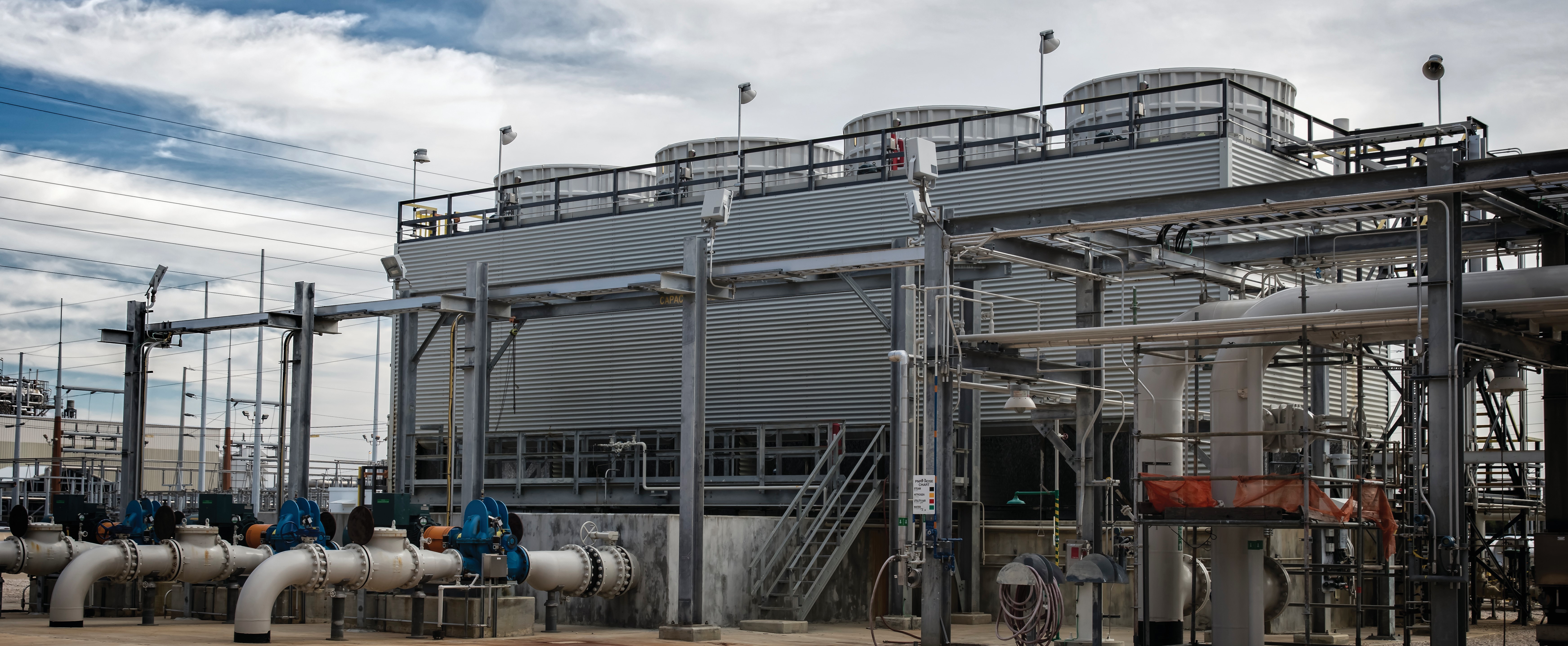

A fully integrated North American steel mill runs a secondary non-contact cooling tower that provides cooling to the plant’s closed loop heat exchangers.
To mitigate deposit issues caused by calcium and phosphate, the steel mill was feeding acid to depress pH but still had to reduce cycles of concentration to only two. This mode of operation generated an excessive amount of blowdown water and sent a lot of treatment chemicals to the drain.
Veolia moved on-site and implemented its GenGard technology, an exclusive treatment program designed to allow systems to handle a high load of contaminants in alkaline conditions safely. GenGard combines a stress-tolerant polymer (STP), alkaline enhanced chemistry (AEC), and halogen resistant azole (HRA) with phosphate-based steel corrosion inhibitors.
The GenGard program allows cooling towers to operate safely and effectively with a much higher calcium and phosphate residual. The STP and AEC polymers keep the calcium and phosphate in solution, greatly reducing the risk of forming deposits. Veolia recommended that the tower operates at four concentration cycles without adding acid for pH depression.
结果
Increasing the system’s cycles from two to four significantly reduced the amount of water discharged by blowdown and saved an equal amount of freshwater. These water savings amounted to over 250MM liters per year, a reduction of 50%.
如果没有STP和AEC的分散性能,该厂以前每年要花费5,000美元的酸来充分压制pH值,并且由于高排污率,还过多地使用沉积和腐蚀控制化学品。
图表1显示,在应用GenGard技术时,浓度周期(黄线)从2个增加到4个,钙的周期(蓝线)显示出类似的趋势。这表明这是一个下降的趋势,同时钙元素没有沉积。Veolia提供的是一流的水处理方案,不含酸的同时不会在系统中形成有害沉积。循环次数的增加减少了水和化学品的消耗量。
Total savings equate to $28,000 per year and eliminate the environmental, health & safety (EHS) risk associated with the use of acid.
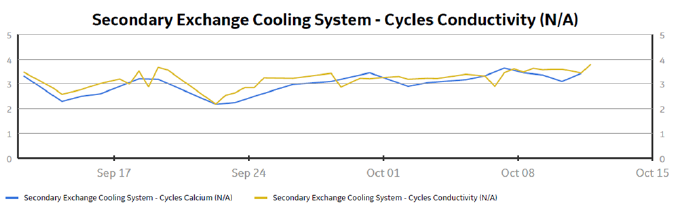
Graph 1: Cycles of calcium remain in line with tower cycles, showing no loss of calcium due to deposition within the system without pH depression